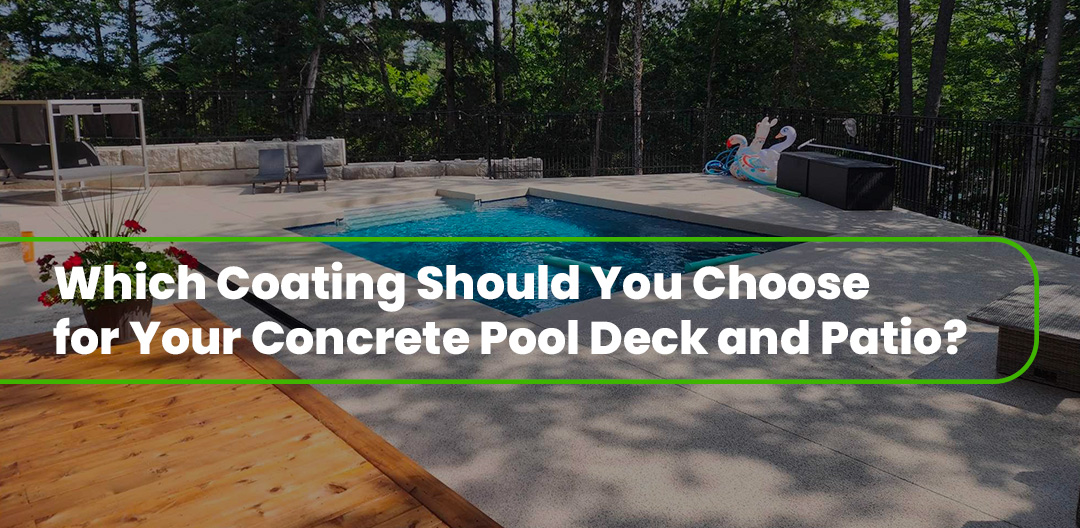





Which Coating Should You Choose for Your Concrete Pool Deck and Patio?
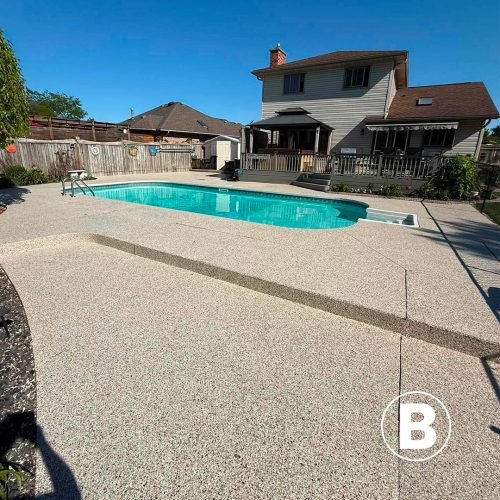
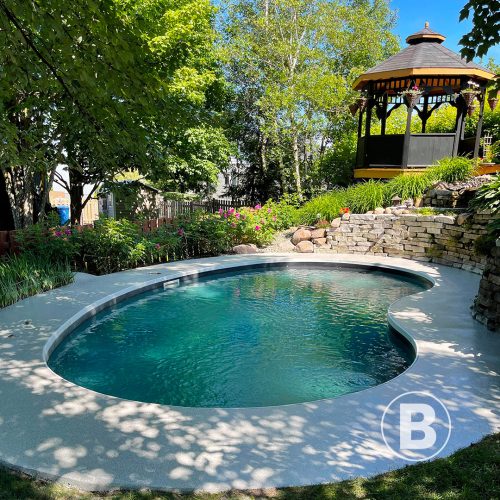
For a concrete pool deck or patio that faces Canadian winters and a full summer of sun, the most durable coating is a polyaspartic system with decorative flakes. It stands up to chlorine, UV and freeze-thaw cycles without yellowing or peeling, and its textured finish stays non-slip even when wet. Here is how it compares with the other options, and how to know which one fits your slab.
What coating holds up best on a concrete pool deck?
A coating around a pool faces three stresses at once: chlorinated water, direct sun and wet feet. Not every product survives those conditions.
Here is how the common options rank for an exposed outdoor slab:
| Option | UV performance | Slip resistance | Realistic lifespan |
|---|---|---|---|
| Polyaspartic with flakes | Excellent, will not yellow | High (flakes + additive) | 15 to 20+ years |
| Epoxy | Poor, yellows in sun | Medium | Not suited to outdoors |
| Concrete paint | Poor | Low | 1 to 3 seasons |
| Sealer alone | Good (protects, does not transform) | Varies | 2 to 5 years |
Epoxy belongs indoors, like a basement, where it stays out of the sun. Paint chips quickly under chlorine and frost. A polyaspartic system with flakes ticks the right boxes for a pool deck, which is also why it leads the way for exterior concrete surfaces.
Can you use epoxy on a patio or pool deck?
No. Epoxy belongs indoors, like a basement, where it is protected from the sun. Outdoors, UV light turns it yellow within a season or two, and freeze-thaw makes it brittle and prone to peeling. If you have searched for an epoxy patio or exterior concrete epoxy, the finish you actually want is polyaspartic: it gives the same seamless, glossy look but stays UV stable, flexible and bonded through Canadian winters. For a pool deck, that difference separates a coating that lasts two decades from one that fails in two summers.
Why does polyaspartic suit the Canadian climate?
Across most of Canada, an outdoor slab goes through dozens of freeze-thaw cycles each winter. Water seeps into hairline cracks, freezes, expands and breaks apart a rigid coating. Polyaspartic stays slightly flexible and bonds deep into the concrete, so it moves with the slab instead of lifting off it.
Its other strengths for our climate:
- UV stable, so the colour holds without yellowing season after season.
- Resistant to chlorine and to the de-icing salt and calcium used in winter.
- Sealed and waterproof, so moisture no longer soaks into the slab.
- Installs across a wide temperature range, including cooler spring and fall days.
The system often goes down in a single day, which keeps your yard out of service for less time.
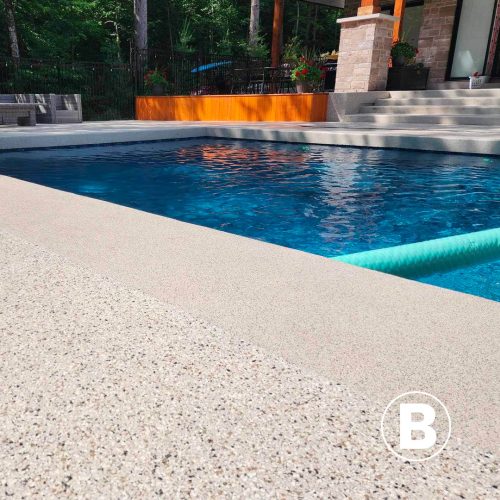
Is a concrete pool deck coating slip-resistant?
Yes. Around water, traction is not a nice-to-have, it is a safety issue. The polyaspartic system uses decorative flakes that build natural texture, and a slip-resistant additive can be mixed into the topcoat for even more grip.
The result is a surface that stays safe under wet feet while keeping a clean, finished look. You set the level of texture to match the use: more aggressive near the water, smoother on a lounging patio. That is a clear edge over smooth pavers or paint, which turn slippery the moment they get wet.
Do you need to repair the concrete first?
Almost always, yes. A coating does not fix damaged concrete, it follows the surface underneath it. Cracks, surface spalling and frost-damaged spots have to be repaired first, or the flaws show through and shorten the life of the finish.
The good news is that an old cracked slab rarely needs to be torn out. Resurfacing usually brings it back: repair, mechanically prepare the surface, then apply the system. A twenty-year-old pool deck can come back to a sound finish for the next two decades. The concrete resurfacing prep stage is what determines how long the finish lasts.
Sealer or full coating: which one?
A sealer and a full coating do different jobs. A sealer protects existing concrete from water and stains, but it does not change the colour or texture, and it has to be reapplied every few years. It is protection, not transformation.
A polyaspartic system with flakes lays a new surface over the slab: your choice of colour, a non-slip texture and lasting waterproofing. If your concrete is in good shape and you only want to protect it, a quality sealer is enough. If you want a durable, non-slip finish that changes the look of your yard, the full system is the investment that lasts.
How soon can you use the surface?
This is where polyaspartic wins: it cures far faster than an indoor epoxy floor. Depending on temperature and humidity, you can usually walk on it within hours, and it reaches full strength in about 24 hours. Your local franchise partner will confirm the timeline based on the conditions on install day.
Get straight answers on your project
Every slab is different: age, cracks, sun exposure, distance from the water. Before recommending a coating, a local franchise partner visits to inspect your concrete, understand how you use the space and propose the right solution. The visit is there to assess the work first, not just hand over a number. If you want a quick figure, you can also get an instant quote by phone.
Get your instant quote from a franchise owner near you.
YOUR GARAGE CAN BE BETTER. WE’D BET ON IT!
A turnkey setup, without the hassle.
Still got questions?
Let us know!
Fill the form bellow